
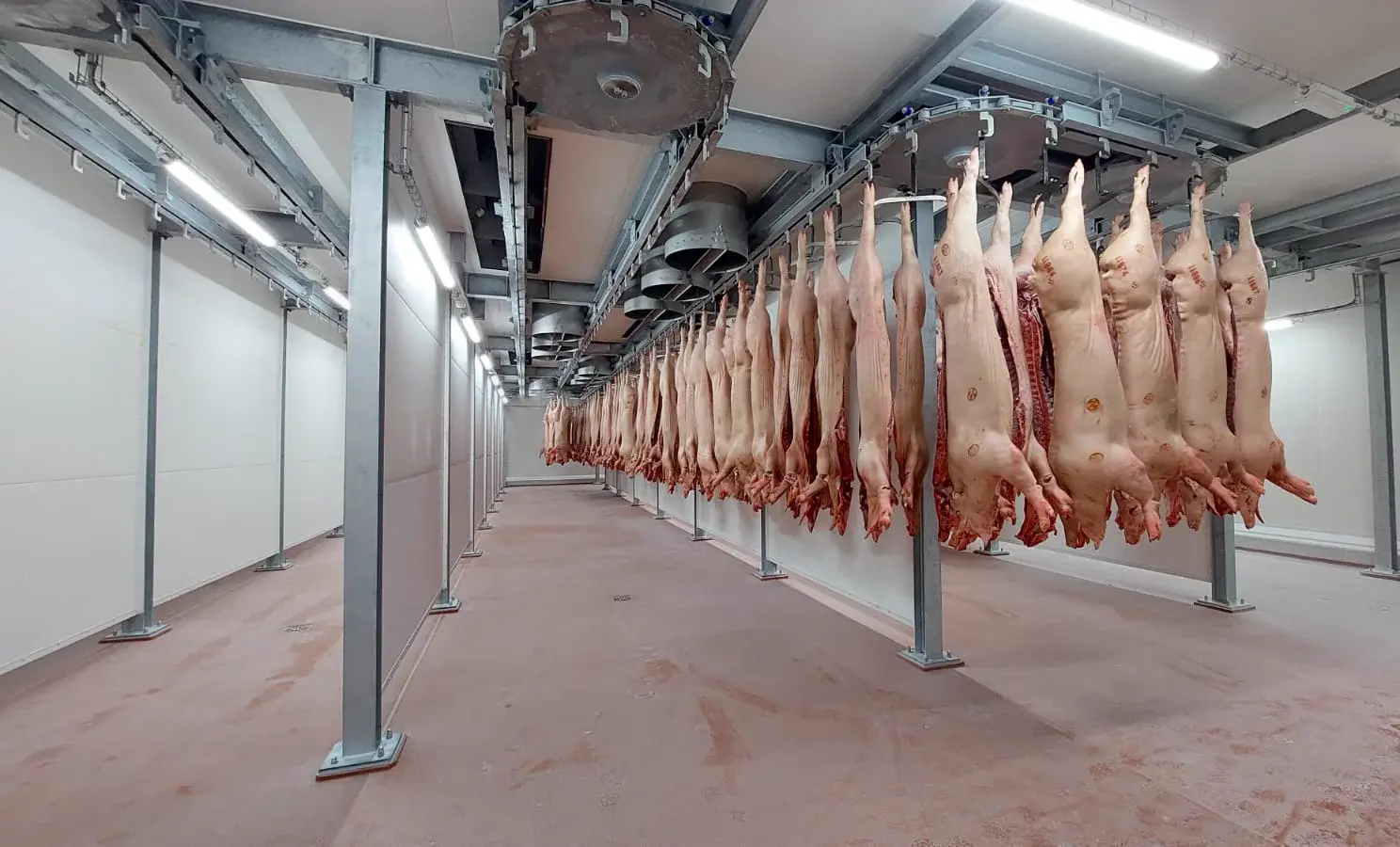
Pork Plant & Pig Slaughterhouse Design
Pork Plant Design
A pig slaughterhouse only earns its return if yield, chilling, meat quality and welfare are engineered together. INTERCOOL designs pork plants on a holistic, vendor-neutral basis — balancing nine factors at once so the plant protects margin from the live animal through to the cut.
What does pork plant design involve?
Pork plant design is the engineering of a pig slaughterhouse and processing plant so that every stage — from the arrival of live animals through slaughter, chilling and cutting — works as one optimised system. The aim is not simply a building that functions, but a plant that maximises yield, protects meat quality, controls energy and water, and meets welfare and food-safety obligations.
What makes pork distinctive is how tightly these factors interact. A choice made for animal welfare changes meat quality; a chilling decision changes yield and energy use; an automation choice changes labour cost and product consistency. INTERCOOL designs the plant holistically, weighing all of these together rather than optimising one in isolation and paying for it elsewhere.
Definition
- Holistic pork plant design
Holistic pork plant design is the practice of engineering a pig slaughterhouse so that product quality, yield, automation, infrastructure, traceability, energy, hygiene, sustainability and animal welfare are balanced as a single system — because in a pork plant each of these factors changes the others, and optimising one in isolation usually erodes another.
Why a holistic approach drives pork profitability
In pork, the margin is made or lost in fractions of a percent — and the biggest levers are yield and chilling. A 1%-point improvement in slaughter yield is worth roughly a 12.5% reduction in labour costs, which is why yield-protecting design decisions repay themselves many times over.
Chilling is where much of that yield is defended. Reducing chill loss from 2% to 1% saves more than €1.3 per carcass, and a well-designed two-stage quick-chill plus equalization (E-QCT) process can increase profit by €3 to €5 per pig carcass while improving meat quality. Better chilling also lifts colour — up to one point on the Japanese Colour Scale, worth more than €0.50 per kilogram in premium markets. None of these gains exist in isolation: they come from designing welfare, slaughter, chilling and cutting as one chain.
The nine-factor holistic approach to pork plant design
Product quality & market demands
The product range and quality targets the plant must hit for its markets drive every downstream design choice.
Yield & by-product utilization
Maximising saleable yield and the value recovered from by-products — the single largest economic lever in pork.
Automation & productivity
Automation matched to labour cost, throughput and product consistency, not technology for its own sake.
Infrastructure
Building, layout and material flow engineered for hygienic, efficient operation and future flexibility.
IT & traceability
Data and traceability systems that meet market requirements and support quality control.
Energy, resources & carbon
Energy-efficient refrigeration and utilities with heat recovery to cut OPEX and carbon.
Hygiene & shelf life
Hygienic zoning and process control that protect food safety and extend shelf life.
BAT & sustainability
Best-available-techniques and sustainability built into the scheme from the design stage.
Animal welfare & ethics
Welfare-led handling under EC 1099/2009 that also protects meat quality and yield.
Pork chilling and quality — typical design parameters
| Carcass entry temperature | ~39–40°C at the start of chilling |
|---|---|
| Target temperature | ~5°C within 20–24 hours post-slaughter, ready for cutting |
| Quick chill tunnel (QCT/E-QCT) air | Can drop below −20°C for rapid surface cooling |
| Equalization (EQ) stage | 0–4°C, stabilising over 16–20 hours to an even 4–5°C |
| Chill-loss reduction value | 2% → 1% saves >€1.3 per carcass; E-QCT adds €3–€5 profit per pig |
| Meat-quality outcome | Controlled pH decline favours RFN meat over PSE and DFD |
Pork plant results, by the numbers
0.8–0.9%
cooling shrinkage at 14 hours
Existing pig slaughterhouse, Spain — 800 pigs/h on 86 kg carcasses
<1.3%
chill loss, with slaughter yield up over 1%
Existing pig plant, Poland — 280 carcasses/h
1.0%
chill-loss design target
New-build pork plant, Mexico — 500 pigs/h greenfield
From welfare to colour: engineering meat quality
Meat quality in pork begins before slaughter and is locked in during chilling. Calm, well-designed live animal handling under EC 1099/2009 reduces the pre-slaughter stress that triggers a fast pH decline and pale, soft, exudative (PSE) meat. Controlling the rate of cooling and managing the post-mortem pH decline then steers the carcass toward the desirable reddish, firm, non-exudative (RFN) condition and away from PSE or dark, firm, dry (DFD) outcomes.
The payoff is both quality and price: a colour improvement of up to one point on the Japanese Colour Scale can add more than €0.50 per kilogram in premium markets, while reduced drip loss protects saleable weight. This is why pork plant design treats handling and chilling as one continuous quality chain rather than separate trades.
Pork plant design — frequently asked questions
What makes pork plant design different from general plant design?
In pork, yield, chilling, meat quality and welfare interact unusually tightly — a decision for one almost always changes another. INTERCOOL designs against a nine-factor holistic framework (product quality, yield and by-products, automation, infrastructure, IT and traceability, energy, hygiene, BAT and sustainability, and animal welfare) so the whole plant is optimised rather than one factor at the expense of the rest.
How much does chilling affect pork plant profitability?
A great deal. Reducing chill loss from 2% to 1% saves more than €1.3 per carcass, and a well-designed two-stage E-QCT process can add €3 to €5 of profit per pig while improving meat quality and colour. Chilling is one of the largest controllable influences on a pork plant's margin.
Why does a 1%-point yield gain matter so much?
Because of its leverage: a 1%-point improvement in slaughter yield is worth roughly a 12.5% reduction in labour costs. That is why yield-protecting design — in handling, slaughter line and chilling — is the highest-return investment in a pork plant.
How does the design protect meat quality?
By controlling pre-slaughter stress and the post-mortem pH decline. Calm handling and controlled chilling steer carcasses toward reddish, firm, non-exudative (RFN) meat and away from pale, soft, exudative (PSE) and dark, firm, dry (DFD) outcomes — protecting both grade and saleable weight.
Is INTERCOOL tied to particular equipment suppliers?
No. INTERCOOL has no in-house manufacturing and no proprietary equipment range, so equipment is specified on best-fit and best-value grounds for the project rather than to sell a particular supplier's products.