
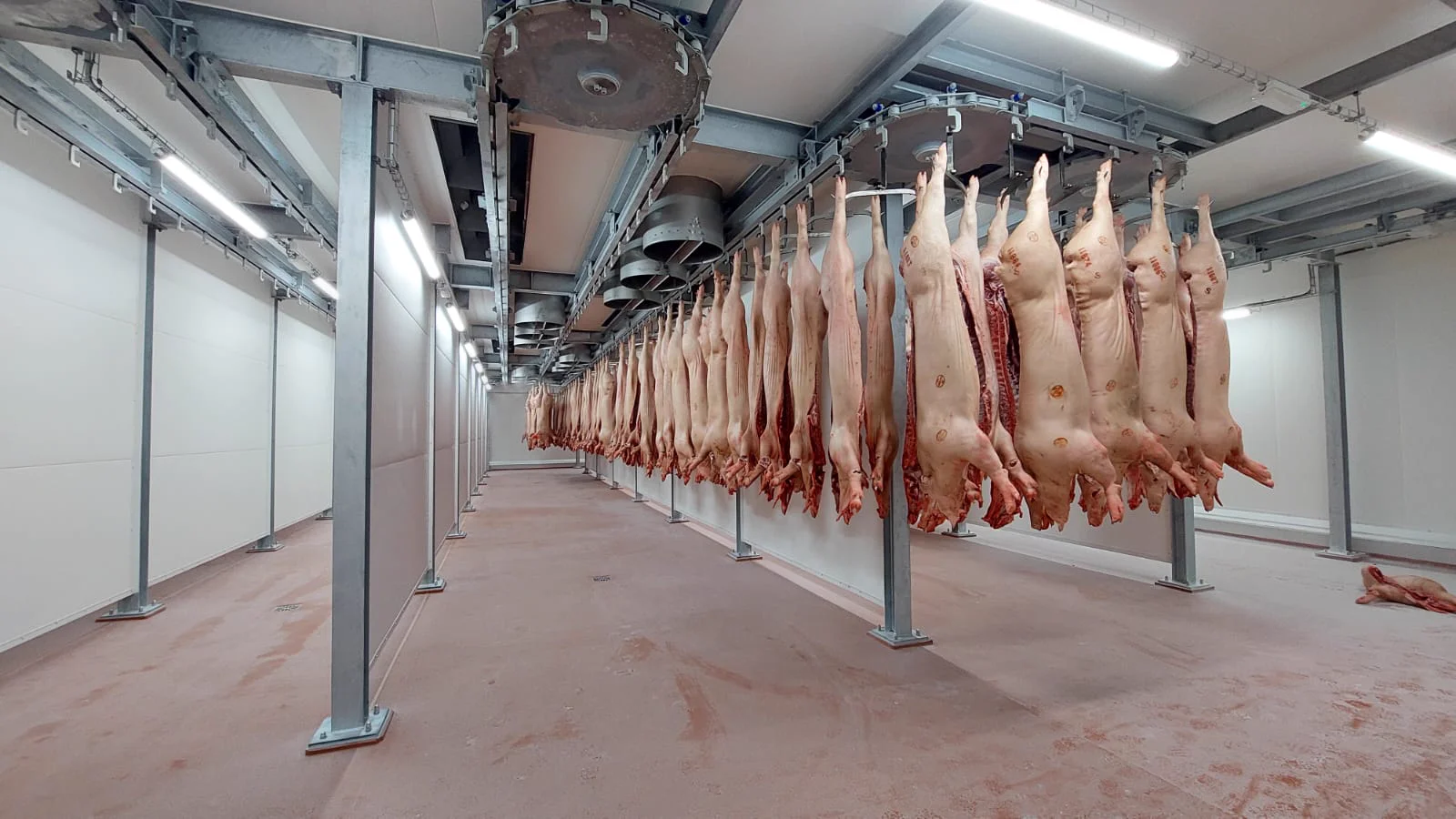
Carcass Chilling Process Design
Carcass Quick-Chill (E-QCT) Process Design
Every extra tenth of a percent of chill loss leaves the plant as lost yield. INTERCOOL designs air-based carcass chilling processes — two-stage quick-chill and equalization — that protect weight, meat quality and margin from the moment the carcass enters the cooler.
What is carcass quick-chill (E-QCT)?
Carcasses enter the chilling process at roughly 39–40°C. The industry standard is to bring this down to around 5°C within 20 to 24 hours post-slaughter, at which point carcasses are ready for cutting and deboning. INTERCOOL's chilling processes use air as the chilling medium — high air velocity and low temperature — engineered around your carcasses and throughput.
The two-stage approach is what gives control. In a quick chill tunnel (QCT / E-QCT) the process air can drop below −20°C for rapid surface cooling, while a following equalization (EQ) stage at 0–4°C lets the temperature stabilise uniformly to an even 4–5°C. Conventional batch chilling, by contrast, typically holds air above 0°C throughout. The method — and how it is engineered around your carcasses and throughput — is what determines yield, meat quality and running cost.
Definition
- Carcass quick-chill (E-QCT)
Carcass quick-chill is an air-based chilling method in which carcasses are rapidly cooled in a quick chill tunnel (QCT / E-QCT) using high-velocity air below −20°C, then held in an equalization (EQ) stage at 0–4°C until the temperature stabilises to an even 4–5°C. Designing it around the carcass profile controls chill loss — the evaporative weight loss that would otherwise leave the plant as lost yield.
Why chilling method drives quality, chill loss and profit
Chilling is not just refrigeration — it is one of the largest controllable influences on profitability. Reducing chill loss from 2% to 1% can yield cost savings of over €1.3 per carcass. The same process discipline improves meat colour: an uplift of up to one full point on the Japanese Colour Scale can raise product value by more than €0.50 per kilogram in premium markets.
Chilling also governs how muscle becomes meat. Controlling the rate of cooling and pH decline reduces the incidence of PSE (Pale, Soft, Exudative) meat and protects against excessive drip loss, steering carcasses toward the desirable RFN (Reddish, Firm, Non-exudative) condition rather than PSE or DFD (Dark, Firm, Dry) outcomes. Designed well, a two-stage quick-chill process can increase profit by €3 to €5 per pig carcass.
How the two-stage E-QCT and EQ process works
The quick-chill principle was refined from the DMRI quick-chill process developed in the 1970s. Its current form — E-QCT (Enhanced Quick Chill Tunnel) — pairs two equally important stages, engineered from your carcass data.
Establish the design basis
The process is engineered from your slaughter capacity and carcass characteristics — hot carcass weight, lean-meat percentage and back-fat thickness. INTERCOOL compiles this in proprietary software that simulates the chilling process and predicts the resulting chill loss before a single component is purchased.
Quick chilling (QCT)
High air velocity and low temperature — process air can drop below −20°C — drive rapid surface cooling and crust freezing, while the core temperature falls at a rate that varies with carcass size.
Equalization (EQ)
Low air circulation at 0–4°C lets the temperature stabilise uniformly across the carcass over 16–20 hours, reaching an even 4–5°C cutting temperature throughout.
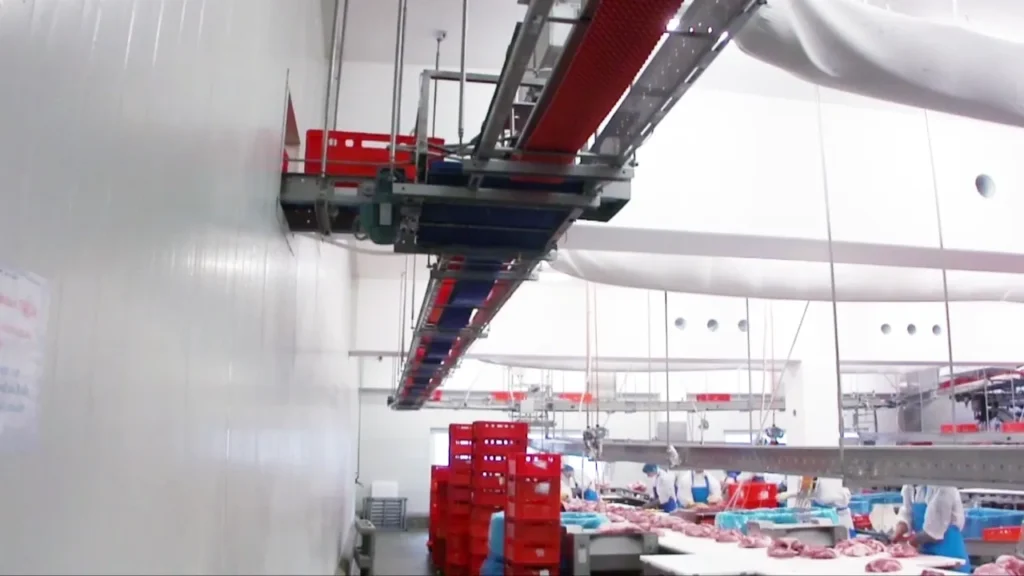
Carcass chilling — typical process parameters
| Carcass entry temperature | ~39–40°C at the start of chilling |
|---|---|
| Target temperature | ~5°C within 20–24 hours post-slaughter (ready for cutting) |
| Quick chill tunnel (QCT) air | Can drop below −20°C for rapid surface cooling |
| Equalization (EQ) stage | 0–4°C, stabilising over 16–20 hours to an even 4–5°C |
| Conventional batch chilling air | Typically held above 0°C throughout |
| Design basis inputs | Slaughter capacity, hot carcass weight, lean-meat %, back-fat thickness |
Our carcass chilling design scope
Chilling process specification
Process design for low chill loss and drip loss, better meat colour and less PSE — sized to your capacity and carcass profile.
Cooling equipment specification
Cooling-capacity calculation, evaporator design, dimensioning and placement, and defrosting sequences — vendor-neutral, best-fit selection.
Conveyor & internal logistics
Rail and conveyor specification matched to throughput and the two-stage QCT plus equalization flow.
Building & insulated structure
Detailed building specifications for the chilling areas, including insulated structure and secondary steel design.
Refrigeration tender review
Independent review of refrigeration contractor documentation so the installed plant matches the specified design.
Installation & commissioning
Supervision during installation and commissioning to verify the chilling process performs to specification.
Proven results in delivered chilling projects
0.8–0.9%
cooling shrinkage at 14 hours
Existing pig slaughterhouse, Spain — 800 pigs/h, 86 kg carcasses, 2,630 m²
<1.3%
chill loss, with slaughter yield up >1%
Existing pig plant, Poland — 280 carcasses/h, 1,300 m²
1.0%
chill-loss design target
New-build pork plant, Mexico — 500 pigs/h, 2,720 m²
A Chill Loss Guarantee, when we design the whole process
Because the chill-loss outcome can be simulated and predicted from the design basis, INTERCOOL can offer a Chill Loss Guarantee — but only when we are involved throughout the entire project and it is executed according to our specifications. As a vendor-neutral engineering partner with no in-house manufacturing, the equipment we specify is selected on best-fit and best-value grounds, not on what we have to sell.
Carcass chilling — frequently asked questions
What is carcass quick-chill (E-QCT)?
Carcass quick-chill is an air-based method: a quick chill tunnel (QCT / E-QCT) rapidly cools the carcass surface with high-velocity air below −20°C, then an equalization (EQ) stage at 0–4°C stabilises the temperature to an even 4–5°C over 16–20 hours. Designed to the carcass profile, it controls chill loss and protects meat quality.
What is the difference between quick chilling and conventional batch chilling?
In a quick chill tunnel (QCT) the process air can drop below −20°C for rapid surface cooling, whereas conventional batch chilling typically holds air above 0°C throughout. Quick chilling, followed by an equalization stage, gives more control over chill loss and meat quality.
How much can reducing chill loss save?
Reducing chill loss from 2% to 1% can yield cost savings of over €1.3 per carcass. A well-designed two-stage quick-chill process can increase profit by €3 to €5 per pig carcass through improved yield and meat quality.
What is the two-stage E-QCT and EQ process?
First, a quick-chilling phase uses high air velocity and low temperature to rapidly cool the carcass surface and form a crust. Second, an equalization (EQ) phase at 0–4°C lets the temperature stabilise uniformly across the carcass over 16–20 hours, reaching an even 4–5°C cutting temperature.
What are PSE, RFN and DFD meat?
They describe meat quality outcomes: PSE is Pale, Soft and Exudative; RFN is Reddish, Firm and Non-exudative (the desirable result); DFD is Dark, Firm and Dry. Controlling the chilling rate and pH decline helps steer carcasses toward RFN and away from PSE and DFD.