
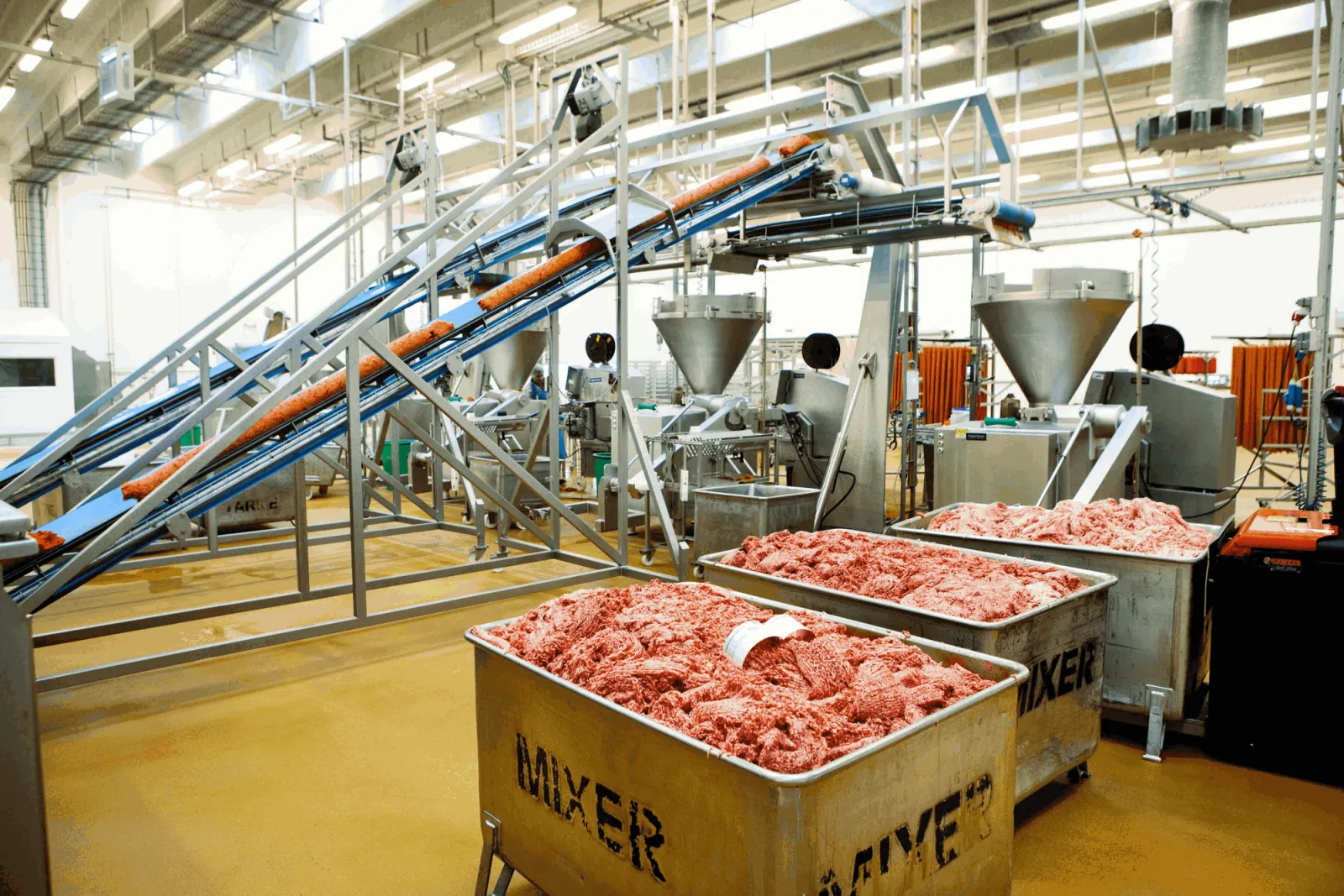
Further processing technologies
How do further processing technologies shape the facility around them?
Further processing technologies are the unit operations that turn trimmed meat into a finished product — grinding, mixing, tumbling, injection, stuffing, cooking, smoking, packaging and freezing — and the facility is engineered around that chain rather than the chain fitted into a building. Each step imposes its own room conditions, hygiene boundary and utility demand, so the chain decides the layout, the refrigeration, the steam and hot water, the compressed air and the water treatment.
What are further processing technologies?
Further processing technologies are the unit operations that convert trimmed meat and prepared ingredients into a finished, higher-value product. On a further processing line they form a chain of nine named steps — grinding, mixing, tumbling, injection, stuffing, cooking, smoking, packaging and freezing — and each product uses the subset its recipe and format require.
Four product families are built from that chain: sausage production, cooked and smoked products, ham & bacon processing, and value-added convenience foods. They share equipment categories but not sequences, which is why the chain is specified per product before any room is sized.
The chain comes first because the facility is its consequence. A successful food processing facility is much more than equipment: it is the integration of process engineering, hygienic facility design, refrigeration, utilities, automation, packaging and logistics into one optimized production environment.
_Reviewed: October 2026_
Definition
- Further processing
Further processing is the production stage that converts trimmed raw material into finished products — sausage, cooked and smoked products, ham and bacon, and value-added convenience foods — through a chain of process technologies running from grinding to freezing.
Why does the chain decide the facility?
Every facility is engineered around products, process flow, food safety, utilities, logistics and future expansion requirements — which is a warning as much as a principle: if the product and its chain are not fixed first, the building, the utilities and the hygiene concept are all sized against an assumption.
The four gains a further processing investment is judged on are all qualitative, and all depend on that order: product quality, from consistent production environments and optimized process controls; higher yields, from reduced losses and improved raw material utilization; lower operating costs, from energy-efficient facility design and optimized production flow; and future flexibility, from a plant designed for growth, automation and product diversification.
The objective for the finished facility is concrete: robust throughput, consistent ingredient quality, safe operation and a practical path from raw-material reception to high-value products.
The nine-step further processing chain
Each step is both a process operation and a demand on the facility.
Grinding
Trimmed raw material is reduced to a defined particle size, in a chilled raw-side room whose throughput sets the buffer upstream of it.
Mixing
Meat, fat and the remaining ingredients are brought to a homogeneous batch. Ingredient logistics management starts here, without crossing raw product flow.
Tumbling
Whole-muscle pieces are worked mechanically so that brine is taken up. Chilled and time-dependent, it fixes vessel count and holding space, not line speed.
Injection
Brine is introduced into whole-muscle product, adding brine preparation and dosing — and with them a water quality, water treatment and cleaning load.
Stuffing
The batch is portioned into casings, moulds or containers. The geometry fixed here governs cooking and smoking times, and so the plant's thermal capacity.
Cooking
Product is brought to its required core temperature. This step converts raw into cooked, making it the main steam and hot water consumer and the hygiene boundary.
Smoking
Smoke and controlled heat develop colour, flavour and surface condition, sharing the thermal services of cooking on the cooked side of the boundary.
Packaging
Cooked product is packed in a controlled cooked-side room. Packaging control systems and packaging integration belong to the process design, not a later fit-out.
Freezing
Product not dispatched chilled is frozen and held. Freezing closes the chain and accounts for much of the plant's refrigeration duty.
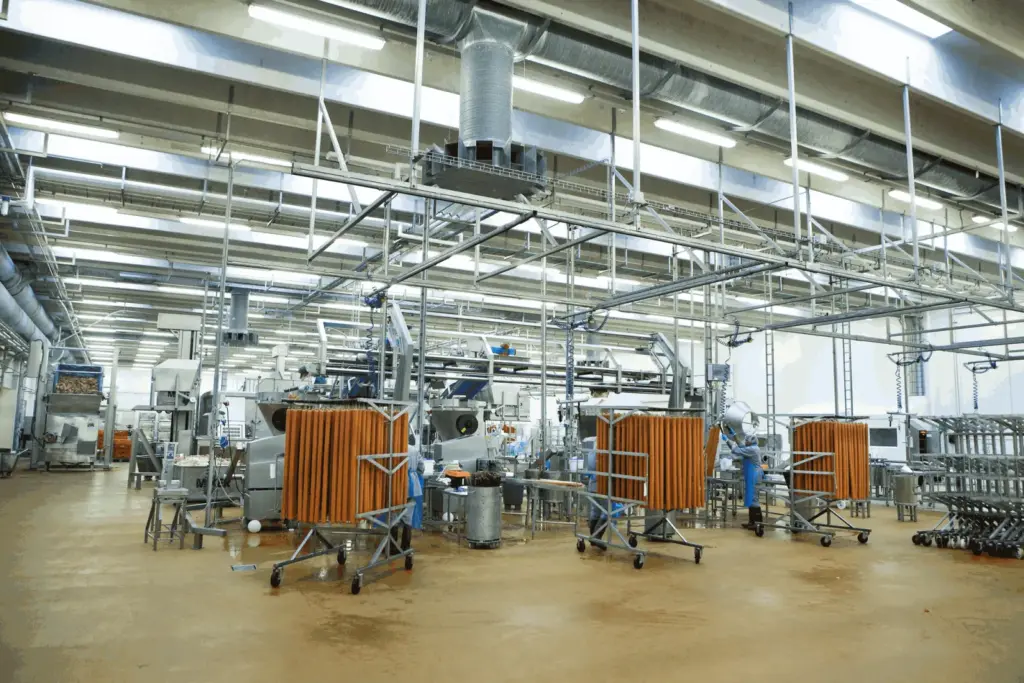
What does the chain demand of the building and the utilities?
Rooms and flow. The chain divides into chilled raw-side rooms, a thermal block, and cooked-side production and packaging rooms. Buildings and infrastructure therefore cover hygienic food facility design, insulated wall & ceiling systems, production & packaging rooms, and expansion-ready layouts — the last because a product mix that gains a step later needs somewhere to put it.
Utilities. Cooking and smoking make steam & hot water generation a primary service; grinding, mixing, tumbling and freezing make refrigeration systems one; injection and cleaning make water treatment solutions one; and the line needs compressed air systems and electrical & automation systems throughout. These are specified as scope, independent of any supplier — solutions are developed together with trusted global technology partners and industry specialists.
Refrigeration boundary. INTERCOOL specifies, dimensions, tenders, reviews and commissions the refrigeration systems a further processing line needs; it does not perform the detailed refrigeration design — that work is consulted to an external refrigeration specialist.
Where does the cooking step put the hygiene boundary?
Cooking changes the product's status, and the layout has to recognise it. Raw and cooked product segregation is one of six principles through which food safety is engineered into a facility, alongside personnel flow control, ingredient logistics management, packaging control systems, equipment sanitation strategy and hygienic zoning concepts.
The boundary runs through the thermal step itself: raw material, personnel, packaging and waste each need a route that does not cross back over it, and the cooked side needs its own entry, cleaning regime and packaging room. EC 852/2004 sets the food hygiene requirements such a layout must satisfy — cheaper to meet with a line of rooms than with procedures layered over a compromised flow.
Scope of supply
Concept & feasibility
Capacity studies, business case development, product portfolio evaluation, and master planning & site layouts.
Process engineering
Further processing technologies, fresh retail processing lines, canning & retort systems, and packaging integration.
Buildings & infrastructure
Hygienic food facility design, insulated wall & ceiling systems, production & packaging rooms, and expansion-ready layouts.
Utilities & process support
Refrigeration systems, steam & hot water generation, compressed air systems, water treatment solutions, and electrical & automation systems.
Frequently asked questions
What does further processing mean in a meat plant?
Further processing is the production stage that turns trimmed raw material into finished products — sausage, cooked and smoked products, ham and bacon, and value-added convenience foods — instead of selling primal or retail cuts. It is carried out with a chain of process technologies running from grinding to freezing.
Which of the nine steps does a sausage line use?
A sausage line is built on grinding, mixing and stuffing to form the product, then cooking and smoking where the recipe calls for them, then packaging and, for frozen formats, freezing. Tumbling and injection belong to whole-muscle products such as ham and bacon.
Why does the cooking step change the plant layout?
Because it changes the product's status. Once product is cooked it must not meet raw material, raw-side personnel or raw-side equipment again, so the cooking and smoking block becomes the boundary between the chilled raw side and the cooked production and packaging side.