
Meat plant design
Cutting and deboning hall design in meat plants
Cutting and deboning hall design fixes the department where chilled carcasses are broken into primals, boned, packed and dispatched — and it sets the cut room's yield ceiling before a single operator is hired. Its two governing inputs are decided upstream: the carcass temperature delivered by chilling, and the capacity balance with the slaughter line ahead of it.
What is a cutting and deboning hall?
A cutting and deboning hall — the cut room — is the department of a meat plant where chilled carcasses are divided into primals, boned out, trimmed, packed and dispatched. In a master plan it is the sixth link in the chain: Raw Material Reception, Unclean and Clean Processing, By-product and Waste Handling, Chilling and Freezing, Buffering Systems, then Cutting, Deboning, Packaging and Dispatch, with Retail and Processing beyond it.
Designing it is largely a matter of deciding what it will be given. The carcass it receives, the temperature that carcass is at, the buffer standing ahead of it and the standard of work inside it are all resolved on the drawing board. Its position on the clean side of the plant is a zoning decision taken at the same stage — see hygienic zoning in slaughterhouse design.
_Reviewed: September 2026_
Definition
- Cutting and deboning hall
The department of a meat plant in which chilled carcasses are cut into primals, deboned, trimmed, packed and dispatched. It follows chilling and buffering in the plant chain and receives carcasses at a controlled, uniform cutting temperature.
Why does chilling decide what the cut room can do?
The department's inlet condition is an engineered output of the process before it, not an assumption. Carcasses enter chilling at 39–40 °C, and the industry standard reduces them to around 5 °C within 20–24 hours of slaughter, at which point carcasses are generally processed for cutting and deboning.
Reaching that average is not the same as being ready to cut. An equalisation (EQ) step, run at low air circulation and at temperatures close to the desired cutting temperature — held at 0–4 °C over 16–20 hours — stabilises the whole carcass to an optimal 4–5 °C, giving a consistent and precise uniform cutting temperature instead of a cold surface over a warm deep muscle.
The chilling method follows the meat into the cut room in another way too: it drives drip loss and the incidence of PSE in ham and loin cuts. Capacity is inherited as well, so the department is balanced against the slaughter line, with buffering systems ahead of it to absorb the difference.
Why is cut-room yield decided at the design stage?
Yield is governed by the raw material the department is given and by the discipline of the work inside it. The raw-material conditions that set the ceiling are specific: PSE, bruisers, surface colour, hardness or softness, whether the right carcass or prime goes to the right product, carcass size and uniformity, whether sides are sorted left and right, and a uniform cut temperature.
Two design levers act on that. Eliminating process deviations means standardised cutting and boning, clear product specifications, and work instructions with training. Optimising raw-material-to-product matching means grading and sorting systems plus traceability, so the choice of which carcass goes to which product is made on data.
The prize is larger than it looks: a 1 %-point yield improvement typically translates into a 12.5% reduction in labour costs, as set out in labour productivity in meat processing plants. Designed in from the start: a 40,000 m² greenfield slaughterhouse in South Korea handling 3,000 pigs and 300 cattle per day was built to comply with EU and US standards for slaughtering, cutting, de-boning and hygiene, with the flexibility to add a processing department later.
From chilled carcass to dispatch
Each stage hands the next a defined condition; the layout fixes that sequence.
Equalised carcass in
The carcass arrives from the EQ step at a uniform 4–5 °C, stable through the deep muscle and not only at the surface.
Grading and sorting
Carcasses are graded and sorted so the right carcass or prime meets the right product; size, uniformity and left and right sides are recorded.
Cutting into primals
Standardised cutting against clear product specifications, to work instructions operators have been trained on.
Deboning and trimming
The yield-critical stage, where variability between operators shows up directly in the yield figure.
Packing
Product is packed to the specification of the customer it was matched to, with traceability carried through from the carcass.
Dispatch
Finished product leaves the department through dispatch.
Cut-room design parameters
| Carcass temperature entering chilling | 39–40 °C |
|---|---|
| Industry-standard chilling | To around 5 °C within 20–24 hours of slaughter |
| Equalisation (EQ) step | 0–4 °C, held over 16–20 hours |
| Target cutting temperature | 4–5 °C, uniform through the whole carcass |
| Hip suspension window (beef, if used) | Within the first 48 hours post-slaughter |
What the design project covers
Layout and specifications
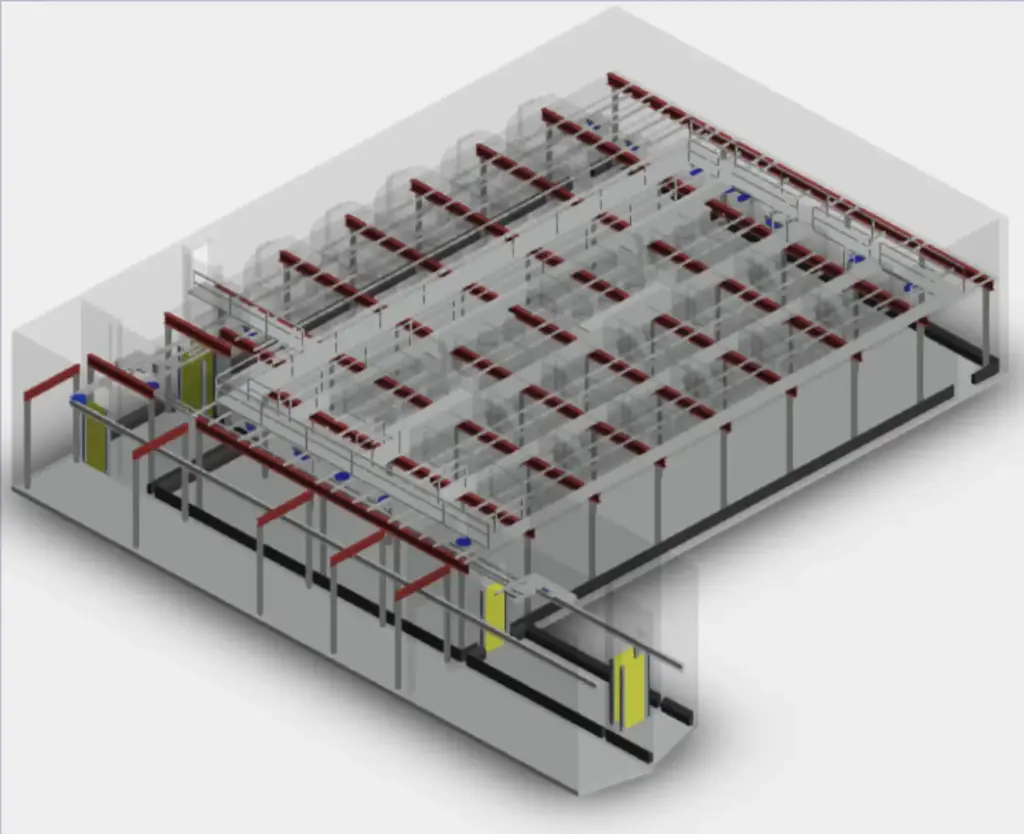
The department layout, the equipment positions and the specifications that equipment must meet.
Products and processes
Which products the department must produce, and the processes required to produce them.
Flexibility demands
The flexibility to be retained, so capacity or a processing department can be added later.
Services and utilities
The utilities the department draws, specified within the plant's wider utility systems.
Logistics and traceability
Internal logistics flows, and the traceability that makes raw-material-to-product matching data-driven.
Hygiene and food safety
The hygiene and food-safety regime, with best-practice guidelines for quality and shelf life.
Vendor-neutral equipment selection
No in-house manufacturing and no tie to proprietary equipment: best-fit cut-room equipment, sourced competitively.
Proof from the drawing board
40,000 m²
greenfield slaughterhouse designed to EU and US standards
South Korea: 3,000 pigs and 300 cattle per day
68 years
of meat-plant design and engineering
Founded 1958
200+
completed projects worldwide
Vendor-neutral, with no in-house manufacturing
Cutting and deboning hall design — frequently asked questions
At what temperature should carcasses be cut and deboned?
At a uniform 4–5 °C through the whole carcass. Carcasses enter chilling at 39–40 °C, and the industry standard brings them to around 5 °C within 20–24 hours of slaughter, at which point they are generally processed for cutting and deboning. An equalisation step held at 0–4 °C over 16–20 hours stabilises the carcass to that consistent, precise cutting temperature.
Can cut-room yield be improved without new equipment?
Often, yes. Yield is driven by raw-material condition — PSE, bruisers, surface colour, hardness or softness, carcass size and uniformity, and a uniform cut temperature — and by standardised cutting and boning against clear product specifications, with work instructions and training. Grading, sorting and traceability then allow the right carcass or prime to be matched to the right product.
What changes in a beef cutting and deboning hall?
Two decisions are specific to beef. The ageing method — vacuum ageing against dry or hanger ageing — is a yield decision as much as a quality one: dry ageing adds flavour but carries higher yield losses from evaporation and trimming. And hip suspension, if used, should be performed within the first 48 hours post-slaughter, when it improves tenderness.
Does INTERCOOL supply the cutting and deboning equipment?
No. INTERCOOL has no in-house manufacturing and is not tied to proprietary equipment. Cut-room equipment is specified first, then selected on best fit for the products and the capacity, and sourced competitively on the plant owner's behalf.