
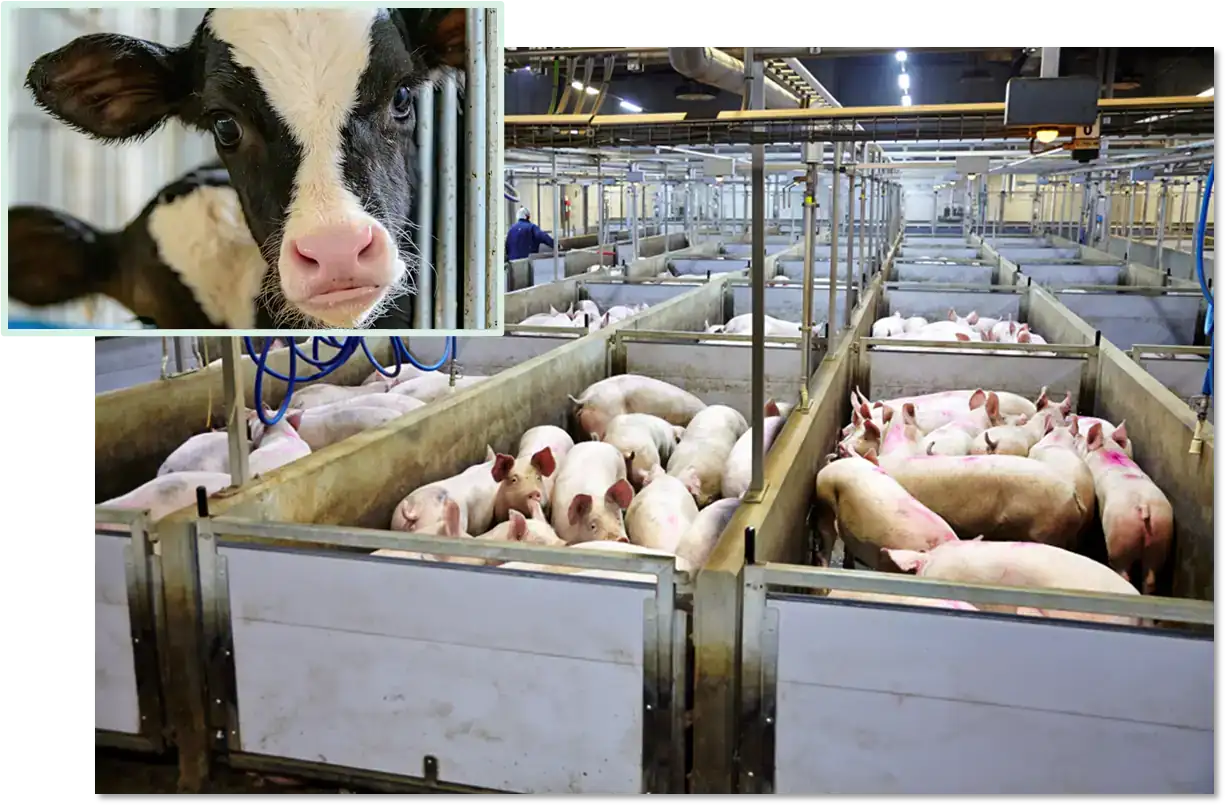
Live animal handling
What is lairage, and how are lairage and stunning designed in a pig slaughterhouse?
Lairage is the holding area of a slaughterhouse between unloading and stunning. It does two jobs: it buffers the arrival of livestock so the slaughter line runs at a constant flow, and it lets the animals rest so that transport stress does less harm to meat quality. A lairage is sized and placed around the stunning system it feeds, and the stunning principle — electric or CO₂ — is chosen on animal welfare, meat quality, reliability, working environment and running cost.
What is lairage in a slaughterhouse?
Lairage is the set of pens, driveways and supporting facilities where animals are held after they are unloaded from the livestock truck and before they are driven to stunning. In a pig slaughterhouse it is the middle link of the live animal handling chain: transport → reception → lairage → stunning → bleeding.
It serves two purposes at the same time. As a production buffer it absorbs the uneven arrival of trucks, so the slaughter line can be fed at a constant rate. As a resting area it gives the animals time to recover from the journey, reducing the negative effects that transport-related stress has on meat quality. A lairage that does only the first job is a waiting room; one designed for both is part of the quality system of the plant.
_Reviewed: October 2026_
Definition
- Lairage
Lairage is the holding area of a slaughterhouse — pens, driveways, drinking, ventilation and inspection facilities — where livestock rest between unloading and stunning. It acts as a production buffer for a constant slaughter flow and as a resting area that limits the effect of transport stress on meat quality.
Why does lairage design affect meat quality and yield?
Meat quality is only as strong as the weakest link between the farm and the chilled carcass, and the hours in lairage and on the driveway are where avoidable stress is either removed or added. A well-designed handling chain shows up downstream as less drip loss, fewer bruised carcasses, less trimming of muscle haemorrhages and spot bleeding, fewer broken limbs, fewer animals dead on arrival, less PSE meat and darker meat — and as fewer operators needed to move animals, because a good layout lets the pigs walk on their own.
The economics are unusual: whether the critical details are executed with care or not, the capital expenditure stays largely the same. Neglecting them, however, substantially reduces the value of the product and makes the slaughtering operations downstream less efficient. That is why the lairage belongs in the design brief of live animal handling systems from the start, together with the stunning and bleeding systems it feeds.
The handling chain and carcass chilling also work together: designed well, the two slow the pH decline after slaughter, reduce protein denaturation and drip loss, and improve meat quality.
How is a lairage sized?
The capacity of a lairage follows from the slaughter plan, not from the plot. The sizing inputs are:
- Production capacity — how many animals the line takes per hour and per day.
- Required area per animal — set by the applicable welfare rules and by the animal types and weight ranges handled: pigs, sows and boars are planned separately.
- Required resting time — how long animals must rest before slaughter.
- Overnight stay — whether animals are held over night, which changes the pen area, bedding, feed and water needs.
- Variation in supply frequency — how unevenly trucks arrive over the day and the week.
Pen group sizes are then aligned with the stunning system, so that a pen can be emptied in step with the stunner's cycle. Handling of unmarked animals and of sick or unfit animals is planned at the same time, with its own pens and routes, and the layout leaves room for a future expansion of the lairage.
Where should the lairage sit in the plant?
Placement decides how animals, vehicles, operators and veterinarians move. A lairage is placed with:
- direct, level-free access to the stunning system;
- access for operators and veterinarians, including ante-mortem inspection facilities;
- separate entry and exit routes for livestock vehicles, with the weighbridge and vehicle sanitation on the way;
- weather-independent, level-free unloading, with the number of unloading ramps set by the unloading time;
- facilities for drivers and for documentation exchange.
Lairage is also among the most odorous and noisy departments of a slaughterhouse, so its position on the site, its ventilation and its ambient climate are decided with odour and noise emissions in mind — both for the neighbours and for the rest of the plant.
From truck to stunner
The route each animal takes, designed as one flow.
Unloading
Level-free, weather-independent unloading from the livestock vehicle, with enough ramps for the planned unloading time.
Reception and ante-mortem inspection
Documentation exchange, identification and veterinary inspection; unfit animals are separated.
Resting in the pens
Pens sized for the group, with suitable floor surface and slope, drains, drinking troughs or nipples, ventilation, and feed and bedding where animals stay overnight.
Driveway
Driveway width, slope, drains and gate design, and lighting, chosen so animals move by their natural behaviour with minimal operator interference.
Stunning
The stunning system receives groups matched to its capacity and cycle time, without avoidable discomfort or distraction.
Stun-to-stick and bleeding
The bleeding system is dimensioned to keep within the maximum allowed stun-to-stick time — see hygienic blood collection for what happens next.
Electric or CO₂ stunning: how is the principle chosen?
Pigs are stunned either electrically or with CO₂ — the form of controlled atmosphere stunning used for pigs, in which groups of animals are lowered into a high CO₂ concentration. Neither is right for every plant. The choice of principle is weighed on six criteria:
- Animal welfare
- Reliability
- Meat quality
- Working environment and labour requirement
- Installation and building requirements
- CAPEX and OPEX
Once the principle is chosen, the system is configured around its capacity, the size of the groups it takes, its cycle time and the stress that cycle causes, the space it needs and the room left to expand. The driveway and stunning system is often supplied as a complete solution by the stunning-system manufacturer; the plant designer's job is to make sure the lairage, the driveway interface, the height difference between stunner entrance and outlet, and the bleeding line around it let that system work as intended — safe and reliable stunning without avoidable pre-slaughter stress.
Lairage and stunning: what to specify
| Production capacity | Number of pens, unloading ramps and stunning capacity |
|---|---|
| Area per animal and resting time | Total pen area; follows the applicable welfare rules |
| Overnight stay | Bedding, feed, water and ventilation demands |
| Animal types and weight ranges | Separate planning for pigs, sows and boars |
| Group size | Must match the stunning system's group size and cycle time |
| Lairage system | Manual or semi-automatic; the interface with the driveway |
| Stunning principle | Electric or CO₂; weighed on welfare, reliability, meat quality, labour, building and CAPEX/OPEX |
| Stun-to-stick time | Dimensions the bleeding system |
| Pens and floors | Building materials, floor surface and slope, pens, gates and locks, drains |
| Climate and emissions | Cooling, heating and ventilation; odour and noise emissions |
| Inspection and traceability | Ante-mortem facilities, handling of unmarked animals, data transfer |
What INTERCOOL designs in the live animal handling chain
Lairage design
Sizing, placement and detailed design of pens, driveways, unloading and inspection facilities.
Stunning system configuration
Choice of principle and configuration of capacity, group size and layout around the stunner.
Bleeding system
Dimensioning to the stun-to-stick time, shackling and sticking work stations, blood collection.
Engineering or process supply
Engineering from concept to start-up with QA of bids and construction, or process supply with installation and commissioning — detailed building design and works excepted.
Which rules apply?
In the EU, the protection of animals at the time of killing is governed by EC Regulation No. 1099/2009, and INTERCOOL's designs are compliant with it. They can also be adapted to other regulations, such as USDA and FDA requirements or local rules, and to specific demands from markets or customers. Designs are developed in cooperation with the local veterinary authorities and, where the plant uses one, its animal welfare consultancy.
Frequently asked questions
What is lairage?
The holding area of a slaughterhouse where livestock rest between unloading and stunning. It buffers arrivals so the line runs at a constant flow and lets animals recover from transport stress, which protects meat quality.
How long should pigs rest in lairage?
The resting time is a design input set by the applicable welfare rules and the plant's quality targets; the lairage is then sized so that every animal can get it at the planned capacity, including overnight stays.
Is CO₂ stunning the same as controlled atmosphere stunning?
CO₂ stunning is the form of controlled atmosphere stunning used for pigs. Whether it or electric stunning suits a plant is decided on welfare, reliability, meat quality, labour, building requirements and CAPEX/OPEX.
Why must pen group sizes match the stunning system?
If groups leaving the pens do not fit the stunner's group size and cycle time, animals queue and are pushed on the driveway — adding stress at the worst moment and disturbing the production flow.
Which regulation governs lairage and stunning in the EU?
EC Regulation No. 1099/2009 on the protection of animals at the time of killing. Designs can be adapted to USDA, FDA or local rules.